

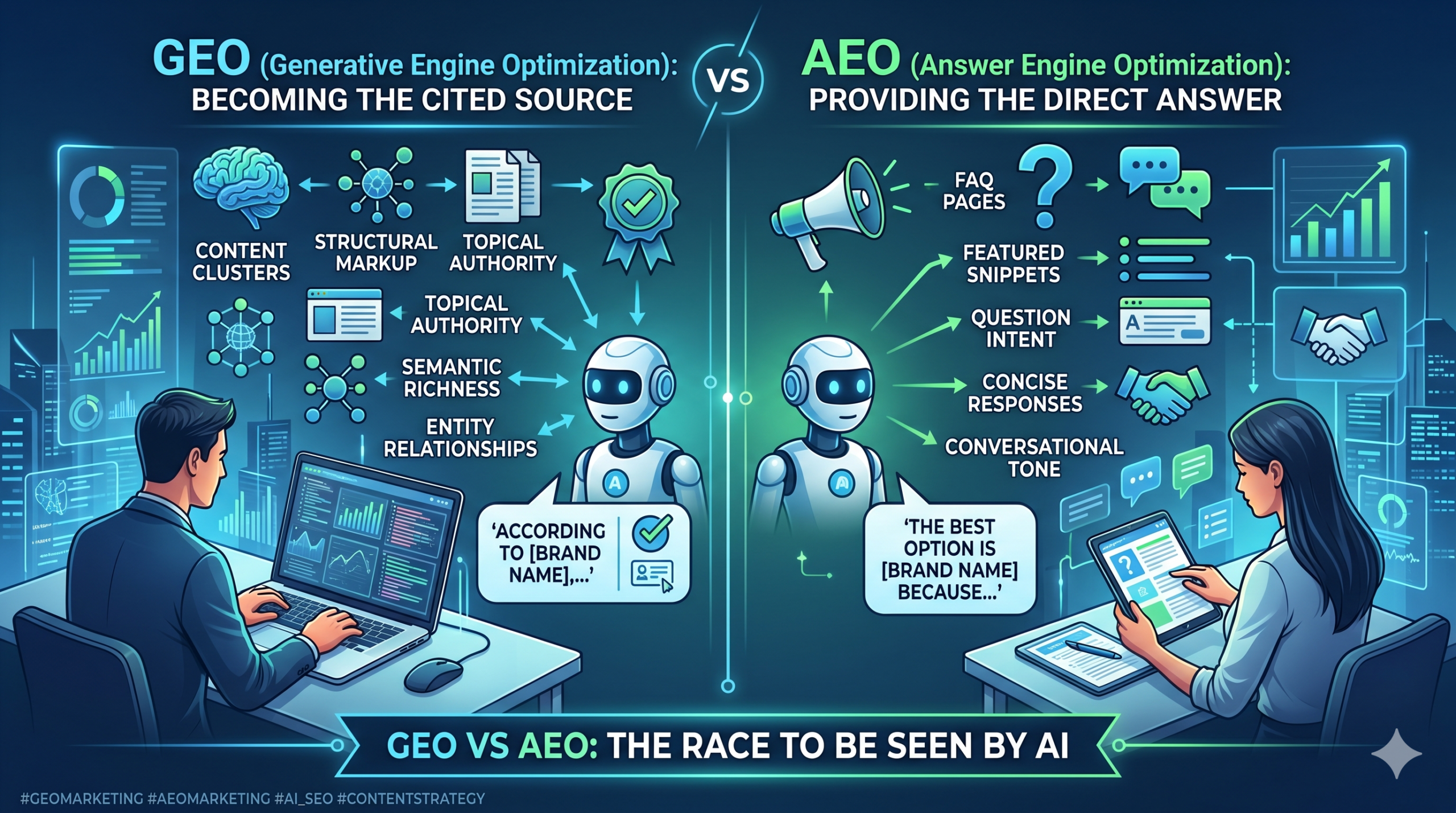
GEO vs AEO: The New Digital Marketing Race to Be Seen by AI
A few years ago, digital marketers had one obsession:
“How do we rank on Google?”
Today, a new question is quietly taking over boardrooms, SEO meetings, and content strategy sessions:
“How do we appear in AI-generated answers?”
Because the internet is changing.
People are no longer just typing keywords into search bars. They’re asking questions directly to AI platforms like OpenAI ChatGPT, Google Gemini, Microsoft Copilot, and Perplexity AI Perplexity.
And when AI gives answers, it doesn’t always show ten blue links anymore.
Sometimes it shows:
- one summarized response,
- one recommended brand,
- one cited article,
- or one trusted source.
That changes everything.
Welcome to the era of GEO (Generative Engine Optimization) and AEO (Answer Engine Optimization).
The Coffee Shop Story That Explains GEO Perfectly
Imagine you own a small coffee roasting company in London.
For years, your strategy was simple:
- write blog posts,
- rank on Google,
- get clicks,
- convert visitors.
It worked.
Then suddenly, traffic drops.
Not because your content became bad.
But because users now ask AI:
“What’s the best ethically sourced coffee brand in the UK?”
And the AI answers instantly.
No scrolling.
No multiple websites.
No endless searching.
Just one synthesized answer.
Your website may still rank #3 on Google…
but if AI never mentions your brand, you become invisible.
That’s the moment most businesses realize:
SEO alone is no longer enough.
So What Exactly Is GEO?
GEO = Generative Engine Optimization
GEO is the practice of optimizing your content so AI systems can:
- understand it,
- trust it,
- extract it,
- and cite it in generated responses.
Think of GEO as:
“SEO for AI-generated answers.”
Instead of optimizing only for search engine crawlers, you optimize for:
- large language models,
- AI retrieval systems,
- semantic understanding,
- conversational queries,
- and synthesized responses.
AI engines don’t simply rank pages.
They:
- read,
- summarize,
- compare,
- infer,
- and generate answers.
That means your content must become:
- clearer,
- more structured,
- more authoritative,
- and more context-rich than ever before.
And What Is AEO?
AEO = Answer Engine Optimization
AEO focuses specifically on helping your content become the direct answer to user questions.
Traditional SEO targeted:
- keywords.
AEO targets:
- questions,
- conversational intent,
- and concise answer formats.
For example:
Old SEO style:
“Best CRM Software 2026”
AEO style:
“What is the best CRM software for small businesses in 2026?”
Notice the shift?
It’s subtle but powerful.
AI platforms are built around conversations, not just keywords.
Why GEO and AEO Matter More Than Traditional SEO
Search behavior is evolving fast.
Users now ask:
- “What’s the safest electric SUV for families?”
- “Which project management tool is best for remote startups?”
- “Summarize the best investment apps for beginners.”
AI systems answer directly.
That creates a winner-takes-most environment.
If your brand becomes:
- the cited source,
- the referenced expert,
- or the trusted answer,
you gain enormous visibility.
If not?
You may slowly disappear from discovery altogether.
The Big Difference Between SEO and GEO
| Traditional SEO | GEO / AEO |
|---|---|
| Keyword focused | Intent focused |
| Ranking pages | Becoming cited answers |
| Optimizing metadata | Optimizing semantic clarity |
| Click-driven | Trust-driven |
| Search engine crawlers | AI language models |
| Short keyword phrases | Natural language questions |
SEO is still important.
But GEO is becoming the next layer on top of SEO.
Not a replacement.
An evolution.
How AI Platforms Actually Choose Content
Most people think AI randomly generates answers.
It doesn’t.
AI systems heavily rely on:
- trusted sources,
- structured content,
- topical authority,
- clear explanations,
- citations,
- and contextual relevance.
If your content is messy, vague, or overloaded with keyword stuffing, AI struggles to use it.
But if your content:
- explains concepts clearly,
- answers questions directly,
- uses strong structure,
- includes statistics,
- and demonstrates expertise,
AI systems are far more likely to reference it.
GEO Technique #1: Write Like a Human Conversation
This is perhaps the biggest shift.
Old SEO content often sounded robotic:
“Best running shoes affordable running shoes top running shoes 2026.”
AI hates that.
Modern AI systems reward conversational clarity.
Instead of writing for algorithms, write like:
- a teacher,
- a consultant,
- or a trusted expert.
Good GEO content sounds natural:
- asks questions,
- anticipates confusion,
- explains context,
- and guides readers step by step.
The irony?
The more human your content feels, the more AI understands it.
GEO Technique #2: Build Topical Authority
AI systems prefer sources that consistently demonstrate expertise.
One random article about cybersecurity won’t make you an authority.
But:
- 50 interconnected articles,
- detailed guides,
- industry insights,
- FAQs,
- case studies,
- and original research?
That signals expertise.
AI platforms increasingly evaluate:
- topical depth,
- consistency,
- and semantic relationships between content pieces.
This is why content clusters matter more than isolated blog posts.
GEO Technique #3: Structure Content for Extraction
AI loves structure.
Why?
Because structured information is easier to summarize and quote.
That means your content should include:
- headings,
- bullet points,
- short paragraphs,
- FAQs,
- definitions,
- comparison tables,
- and clear summaries.
For example:
Bad:
giant walls of text.
Good:
- scannable sections,
- concise explanations,
- semantic organization.
If AI can quickly extract meaning, your chances of being referenced increase dramatically.
GEO Technique #4: Answer Questions Immediately
One mistake many writers make:
They delay the answer.
AI systems prefer content that answers quickly and clearly.
For example:
Question:
“What is AEO?”
Strong answer:
“AEO stands for Answer Engine Optimization, the process of optimizing content to become direct answers in AI-powered search systems.”
Simple. Direct. Extractable.
That’s what AI systems love.
GEO Technique #5: Use Entity-Based Content
Modern AI search heavily relies on entities.
Entities are:
- people,
- brands,
- products,
- locations,
- concepts,
- organizations.
For example:
- HubSpot
- Salesforce
- Ahrefs
- Semrush
AI understands relationships between entities.
When your content clearly connects concepts and entities, it becomes semantically richer and easier for AI to trust.
AEO Technique #1: Create FAQ-Driven Content
AI engines frequently pull from FAQ sections.
Why?
Because FAQs naturally mirror conversational search behavior.
Instead of:
“Benefits of CRM Software”
Use:
- “What are the benefits of CRM software?”
- “Which CRM is easiest for beginners?”
- “How much does CRM software cost?”
This aligns perfectly with AI-driven search.
AEO Technique #2: Optimize for Featured Snippet Style Answers
Even though featured snippets began with Google, the same principle now powers AI answers.
Great AEO content:
- answers immediately,
- stays concise,
- uses plain language,
- avoids fluff.
A strong answer block is often:
- 40–80 words,
- direct,
- easy to quote,
- easy to summarize.
AEO Technique #3: Build Trust Signals Everywhere
AI systems increasingly prioritize trust.
That includes:
- author credibility,
- citations,
- updated statistics,
- expert insights,
- transparent sourcing,
- and real-world experience.
This is closely related to Google’s E-E-A-T framework:
- Experience
- Expertise
- Authoritativeness
- Trustworthiness
AI platforms want reliable answers.
Not content farms.
The Hidden Reality Most Marketers Still Ignore
Many businesses are still producing content for 2018 search engines.
Meanwhile, AI search is accelerating rapidly.
The brands winning right now are:
- adapting early,
- creating semantic content,
- building topical ecosystems,
- and focusing on clarity over keyword stuffing.
This shift is similar to the early days of SEO.
The companies that understand GEO now may dominate AI visibility for years.
What GEO-Optimized Content Actually Looks Like
The best GEO content usually has:
- conversational tone,
- clear definitions,
- structured formatting,
- topical depth,
- entity-rich context,
- direct answers,
- semantic relevance,
- and authentic expertise.
It feels less like “gaming an algorithm” and more like:
genuinely helping someone understand something.
Ironically, AI rewards usefulness better than many old search algorithms ever did.
The Future of Search Is Becoming Invisible
Here’s the strange part.
In traditional SEO, visibility meant:
- rankings,
- clicks,
- traffic.
In AI search, visibility may happen without clicks.
Your brand might be:
- cited,
- recommended,
- summarized,
- or mentioned directly inside AI conversations.
That means the future of digital marketing is no longer just:
“How do we get traffic?”
It’s becoming:
“How do we become the trusted source AI chooses?”
That’s a completely different game.
Final Thoughts
GEO and AEO are not temporary trends.
They represent the next evolution of content discovery.
Search engines are transforming into:
- answer engines,
- recommendation systems,
- and conversational AI assistants.
The brands that succeed will be the ones that:
- educate clearly,
- structure content intelligently,
- build trust,
- and communicate like humans.
Because in the AI era, the best-performing content may no longer be the loudest.
It will be the most understandable.
And the most trusted.
