

Every few years, someone declares that SEO is dead. It happened when social media first surged into our feeds, again when mobile-first indexing forced a design revolution, and once more when voice search began to dominate our living rooms. Now, we are hearing the same funeral dirge for search engine optimization, this time fueled by the meteoric rise of AI-powered search but SEO is not dead yet.
Between ChatGPT, Google AI Overviews, Gemini, and Perplexity, the way people discover information has shifted from a scavenger hunt of blue links to a frictionless, conversational experience. But is SEO really dying—or is it simply undergoing its most significant evolution to date?
The truth is, while the methods are changing, the fundamental need for search engines to organize the world’s information remains. AI is not eliminating the need for SEO; it is refining it. In this guide, I’ll explain why SEO remains one of the most valuable digital marketing skills in 2026 and how professionals can adapt to the AI era to ensure their brands remain visible, authoritative, and trusted.
Why SEO Is Not Dead in the Age of AI
The “SEO is dead” narrative is a recurring trend in the marketing industry, usually triggered by major shifts in how users interact with technology.
When social media platforms launched, critics argued that people would get all their information from Facebook or Twitter, making search engines obsolete. When mobile-first indexing was introduced, many feared that the shift in design would break search results. Similarly, when voice search entered the mainstream, marketers panicked that the lack of a “screen” would destroy click-through rates.
In every instance, these predictions missed the mark. SEO did not vanish; it adapted. It transitioned from simple keyword matching to understanding user intent, mobile responsiveness, and conversational queries. The core goal of search engines has always been to provide the most relevant, high-quality answer to a user’s problem. Whether that answer is delivered via a standard link, a featured snippet, or a generative AI summary, the underlying requirement for optimized, high-authority content is more critical than ever.
What Has Actually Changed?
We have transitioned from Transactional Search—where a user seeks a link to a product—to Generative Search, where the user seeks a synthesized solution.
| Feature | Traditional Search | AI Search |
| Primary Output | List of website links | Synthesized, human-readable summary |
| User Goal | Research and browse | Instant, precise answers |
| Metric of Success | Click-through rate (CTR) | Citations and brand visibility |
| Key Interaction | Clicking the blue link | Conversational follow-up |
AI-powered search creates “zero-click” scenarios where the search engine provides the answer on the page. While this might sound alarming for traditional traffic numbers, it offers a massive opportunity for brands that can position themselves as the “trusted source” behind the AI’s response.
How SEO Is Not Dead but Evolving with AI Search
SEO today is a multi-faceted discipline. To succeed in 2026, you must master several specialized components:
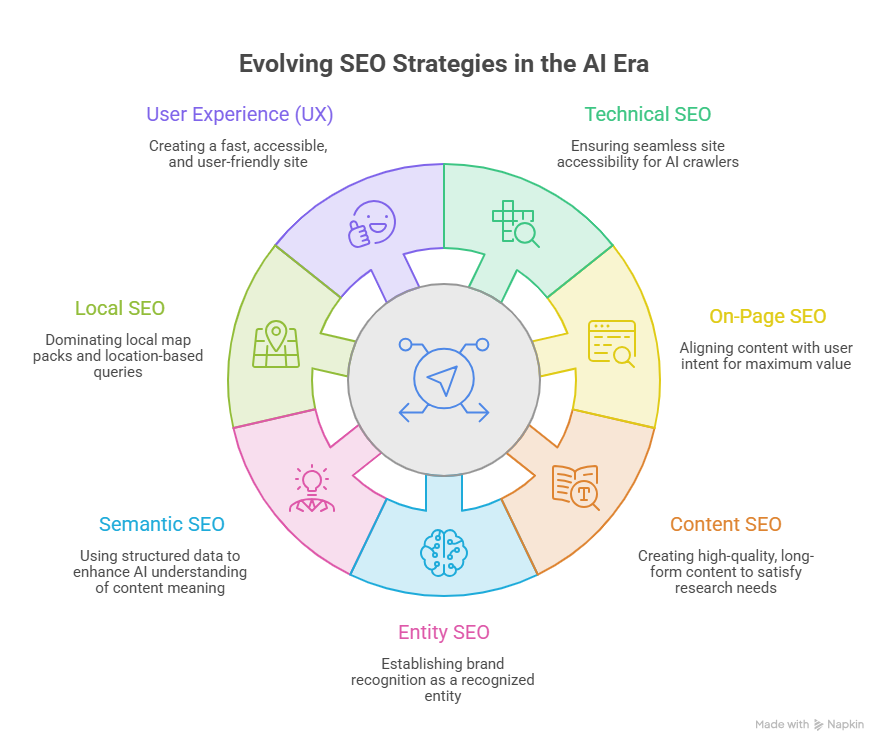
- Technical SEO: Ensuring search engines (and AI crawlers) can access, crawl, and interpret your site’s architecture flawlessly.
- On-Page SEO: Crafting content that aligns perfectly with user intent, ensuring every page provides value.
- Content SEO: Creating high-quality, long-form content that satisfies the user’s research needs.
- Semantic SEO: Using structured data and context to help AI understand the “meaning” behind your content, not just the keywords.
- Entity SEO: Establishing your brand as a recognized “entity” that search engines associate with specific topics.
- Local SEO: Dominating local map packs and location-based AI queries.
- User Experience (UX): Creating a frictionless, fast, and accessible site that users (and AI models) prefer.
How SEO Is Not Dead When Combined with GEO and AEO
As we move deeper into the AI era, two new frameworks are defining the future of search visibility.
Generative Engine Optimization (GEO) focuses on optimizing content so that generative AI models understand, trust, and reference your site as an authority. Meanwhile, Answer Engine Optimization (AEO) prioritizes the direct, concise delivery of answers to specific user questions, making your site the most logical choice for an AI Overview snippet.
AI-powered search platforms—like Google AI Overviews—are increasingly relying on these optimization techniques to pull facts from the web.
👉 [Read our complete guide to GEO vs AEO here to master these new search frameworks.]
What AI Still Needs From Great SEO
A common misconception is that AI creates its own knowledge. In reality, generative AI is a prediction engine that relies on the vast repository of human-created content. AI does not create authority; it identifies it.
It looks for:
- High-Quality Content: Well-researched, original information that provides unique insight.
- Clear Structure: Logical use of H1-H6 tags, lists, and tables that make information easy to digest.
- Internal Linking: A web of related content that demonstrates the depth of your site’s topical authority.
- Trust and Intent: Content that is backed by real-world expertise and perfectly matches what the user is looking for.
If you produce thin, generic content, the AI will ignore you. If you produce authoritative, structured, and insightful content, you become the data source that the AI cites.
10 Reasons SEO Matters More Than Ever
1. Search demand continues to grow
People are searching more than ever, and AI is simply making it easier for them to ask more complex questions.
2. AI relies on trusted websites
AI models are trained to avoid unreliable sources. Building a site with high E-E-A-T (Experience, Expertise, Authoritativeness, and Trust) makes you the preferred source for AI.
3. SEO builds long-term authority
Unlike paid ads, which stop working the moment you stop paying, SEO builds equity that pays dividends for years.
4. Organic traffic is still cost-effective
Even in an AI-driven world, organic traffic remains one of the highest-converting and lowest-cost channels for long-term growth.
5. SEO improves user experience
The factors that help you rank—fast load times, clear structure, and mobile-friendly design—are the same factors that keep human visitors happy.
6. SEO supports AI visibility
By optimizing for AEO, you ensure that your brand is included in the new generation of AI-generated answer summaries.
7. SEO strengthens brand credibility
Being the source of information that an AI recommends builds immense trust with the consumer.
8. SEO works alongside paid media
SEO provides the organic foundation that improves the performance of your paid search campaigns.
9. SEO drives qualified leads
Users who find you through optimized, intent-based search are already in “problem-solving mode” and are more likely to convert.
10. SEO adapts to new technology
SEO is the only marketing discipline that has successfully integrated with every major tech shift over the last 20 years.
The Future of SEO: Why SEO Is Not Dead for Businesses
To stay ahead, you must pivot from “keyword volume” to “information gain.”
- Focus on User Intent: Understand exactly what the user is trying to accomplish.
- Build Topical Authority: Become the “go-to” site for a specific cluster of related topics.
- Use Schema Markup: Speak the language of machines by using JSON-LD.
- Update Evergreen Content: Keep your best-performing articles current.
- Demonstrate E-E-A-T: Clearly display author credentials and original research.
- Improve Core Web Vitals: A slow site is a barrier to both human and AI users.
Common SEO Mistakes in the AI Era
- Keyword Stuffing: AI identifies this as low-quality content; write for people, not bots.
- Thin AI Content: Simply “generating” blog posts with AI without adding original insight creates clutter, not authority.
- Ignoring Search Intent: Creating content that doesn’t answer the user’s underlying question is a waste of resources.
- Weak Metadata: Meta titles and descriptions are your “ad copy” in search; keep them compelling.
The Skills Every Modern SEO Professional Needs
To thrive as an SEO Lead in 2026, your toolkit must expand. You need a mix of technical prowess and strategic vision:
Frequently Asked Questions About SEO Is Not Dead
- Is SEO really dead? No. SEO is not dead. It has evolved to include AI search optimization, GEO, and AEO while continuing to focus on delivering high-quality, user-focused content.
- Why do people say SEO is dead? Many people assume AI will replace search engines. In reality, AI relies on trusted, well-optimized websites, making SEO more important than ever.
- Will AI replace SEO? No, but it is changing the tactics. We are moving from SEO to GEO and AEO.
- Does ChatGPT replace Google? Not entirely. They are complementary; Google integrates AI to answer questions, while ChatGPT acts as a conversational assistant.
- Is SEO worth learning in 2026? Absolutely. As AI search grows, the demand for experts who understand how to structure information for AI models is skyrocketing.
- What are GEO and AEO? GEO (Generative Engine Optimization) is about becoming an AI-cited authority, and AEO (Answer Engine Optimization) is about providing concise answers for AI summaries.
Final Thoughts
The future doesn’t belong to marketers who chase every new algorithm update or panic at the release of every new tool. It belongs to the professionals who understand search intent, create genuinely helpful content, and adapt to how people discover information.
AI is changing the tools we use, but the goal remains the same: helping people find trustworthy, accurate answers. By embracing this evolution, you aren’t just surviving in the AI era—you’re defining it.
Pingback: 10 AI Marketing Tools Every Digital Marketer Should Use
Pingback: Technical SEO Guide : The Beginner's Guide to Technical SEO