
GEO vs AEO: What if your website ranks #1 on Google for every relevant keyword, but you are completely invisible to the millions of users asking questions to ChatGPT or Google’s AI Overviews? It is a unsettling thought, but it is the reality of the 2026 search landscape. For years, we built our digital empires on the bedrock of blue links, meta tags, and backlink velocity. But as search engines evolve from directories into intelligent, conversational agents, the old rules of the game are being rewritten.
We have moved beyond the simple “search and click” paradigm. Today, consumers are turning to generative AI to synthesize, compare, and solve problems instantly. This shift has birthed two new, critical pillars of digital marketing: Generative Engine Optimization (GEO) and Answer Engine Optimization (AEO).
In this guide, we are going to demystify these acronyms. You will learn the fundamental differences between them, why traditional SEO is no longer enough to secure your brand’s future, and how you can position your content to be the definitive source that AI models reference. If you are ready to stop chasing rankings and start chasing citations, keep reading.
GEO vs AEO: Why Traditional SEO Is No Longer Enough
Imagine you are walking through a bustling city looking for the “best coffee shop.” In the old SEO world, you would pull out a physical directory, flip to the “Cafes” section, and pick the one at the top of the list because it paid for a premium ad placement or had the most mentions in the book. You might walk three blocks out of your way just because the directory told you to.
Now, imagine walking into an AI-powered kiosk in that same city. You ask, “I want a quiet coffee shop with fast Wi-Fi and oat milk, near the park.” The kiosk doesn’t show you a directory; it listens, processes your specific needs, and tells you, “Go to The Daily Grind; it fits your criteria perfectly.”
The “directory” (Traditional SEO) still exists, but the “kiosk” (AI Search) is where the customer is actually getting their answers. Traditional SEO focuses on signaling relevance to a bot to earn a link. But AI search is changing customer behavior; users now prioritize the answer over the source. Ranking #1 in a traditional list doesn’t guarantee you’ll be the source of truth in an AI’s summarized response. If your content doesn’t clearly communicate the “why” and “how” to the AI, you will be left out of the conversation entirely. This is where GEO and AEO become essential.
GEO vs AEO: What Is GEO (Generative Engine Optimization)?
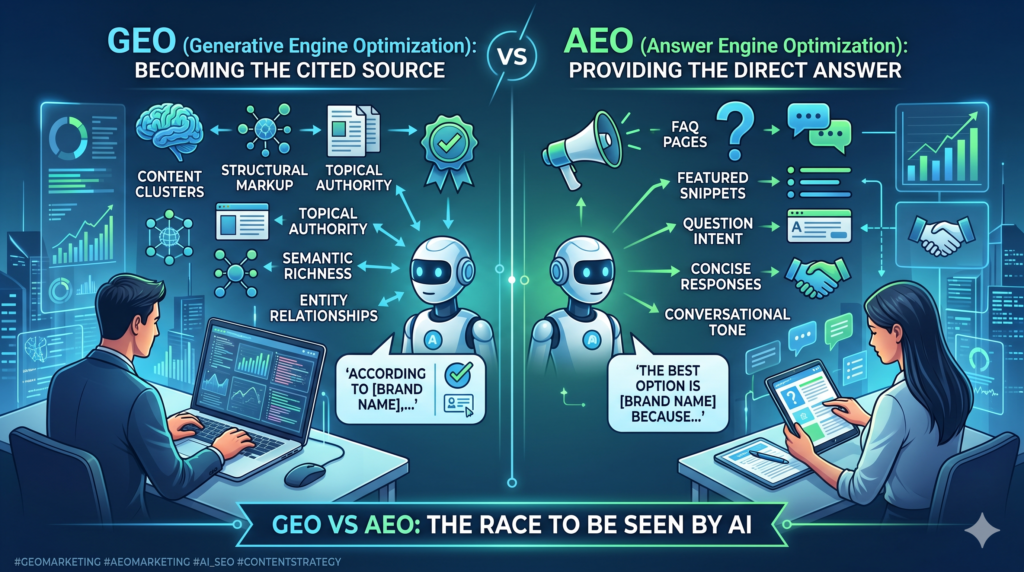
Generative Engine Optimization (GEO) is the practice of optimizing web content specifically for generative AI models—such as Google’s Gemini or ChatGPT—to understand, trust, and ultimately reference your information in their responses.
Unlike SEO, which focuses on manipulating search signals to climb a list, GEO focuses on semantic clarity and architectural trust. AI models ingest vast amounts of data; GEO ensures your content is the data that the AI finds most “digestible” and “authoritative.” It is about making sure that when an AI model processes a topic, your website is indexed as a primary authority on that subject.
Key Takeaway: GEO helps AI understand, trust, and reference your content.
GEO vs AEO: What Is AEO (Answer Engine Optimization)?
Answer Engine Optimization (AEO) is the strategy of formatting your content to be the direct, concise answer to a specific user question. If GEO is about “being the source,” AEO is about “being the answer.”
AEO focuses on the intersection of user intent and the AI’s need for brevity. It is a subset of the broader AI optimization movement, specifically targeting the “Answer Box” or AI Overview experience.
- SEO Keyword: “Best CRM Software”
- AEO Query: “What is the best CRM software for small businesses?”
The SEO approach targets the broad keyword to drive traffic to a homepage. The AEO approach targets the conversational question to provide a snippet of text that the AI can lift, drop into a summary, and credit back to your site.
GEO vs AEO vs SEO
These three pillars are not competitors; they are layers of a modern visibility strategy.
| Feature | SEO | GEO | AEO |
| Focus | Rankings (SERPs) | AI Understanding | Direct Answers |
| Tactics | Keywords & Backlinks | Semantic Context | Conversational Q&A |
| Goal | Clicks/Traffic | AI Citations/Authority | Featured Answers |
The Bottom Line: You need all three. SEO builds the foundation, GEO secures your presence in the AI’s “knowledge base,” and AEO ensures you are the “go-to” answer for specific queries.
GEO vs AEO: How AI Search Platforms Choose Content
Ever wonder why one site gets cited while another is ignored? AI models operate on a multi-step logic chain:
- Understand the Question: The AI strips away the fluff to find the core intent.
- Retrieve Information: It looks for content that maps directly to the concepts in the question.
- Evaluate Trust: It uses E-E-A-T signals to determine which sites are the most reliable.
- Generate an Answer: It drafts a unique summary, pulling facts from the “trusted” sources found in step 3.
Structure and clarity are everything here. If your content is buried in a dense wall of text, the AI will likely skip it in favor of a site that uses clear headings and bulleted lists.
7 Practical GEO Techniques
1. Write Naturally
AI models are trained on human language. Avoid stiff, robot-sounding keyword-dense copy. Write as if you are explaining a concept to a colleague.
2. Build Topical Authority
Don’t just write one post about “AI Marketing.” Write ten posts covering every angle of it. When your site is dense with related, high-quality content, the AI recognizes you as a subject matter expert.
3. Use Clear Headings
Use your H2 and H3 tags to pose questions or define sections clearly. This acts as a roadmap for the AI to “index” your thoughts.
4. Answer Questions Directly
Avoid lengthy intros. State the answer clearly, then expand on it. This makes it easier for the AI to extract your response.
5. Add FAQs
FAQ sections are a goldmine for AEO/GEO. They allow you to address the dozens of “long-tail” questions your users are asking.
6. Improve E-E-A-T
Experience, Expertise, Authoritativeness, and Trustworthiness. Ensure your articles have author bios, references to external studies, and are updated regularly.
7. Keep Content Updated
AI models favor the latest information. A guide from 2022 won’t be as “trusted” as one updated in 2026.
5 AEO Best Practices
H3: Answer the Main Question First
When someone searches “How to optimize for AI search,” start your paragraph with “To optimize for AI search, you must focus on structured data and conversational content.” Don’t bury the lead.
H3: Use Conversational Language
Use words like “you,” “your,” “we,” and “I.” AEO is about mirroring the user’s conversational style.
H3: Write Short Answer Blocks
Break content into chunks of 40–60 words. This length is the “sweet spot” for AI models looking for snippets to insert into summaries.
H3: Use Schema Markup
Implement FAQ or Article Schema. This is the “hidden” code that tells the AI exactly what your content is about.
H3: Create FAQ Sections
Dedicate space to answering the “who, what, when, where, and why” of your topic. This is the most direct way to get featured in AI Overviews.
Common Mistakes to Avoid
- Keyword Stuffing: The AI will flag your content as low quality.
- Thin Content: If you don’t provide deep value, you won’t be cited.
- Ignoring AI Search: If you aren’t optimizing for AI, you are ceding the top of the SERP to competitors who are.
- No Internal Links: Help the AI navigate your site’s hierarchy.
- Poor Readability: If a human can’t read it easily, the AI will struggle to parse it.
Why GEO and AEO Matter for the Future
We are entering a world of “zero-click” searches. If your goal is only traffic, you will be disappointed. If your goal is brand visibility and trust, you will dominate. The future of search is about becoming the trusted source that AI chooses to quote. If you aren’t in the summary, you aren’t in the conversation.
GEO vs AEO: Frequently Asked Questions
What is GEO?
GEO stands for Generative Engine Optimization, focused on making content understandable and trustworthy for AI models.
What is AEO?
AEO stands for Answer Engine Optimization, focused on providing direct answers to specific user questions.
Is SEO still important?
Yes, SEO remains the foundation for organic visibility, but it must now be paired with GEO and AEO.
Can my website appear in AI-generated answers?
Yes, by providing high-quality, structured, and authoritative answers that AI models trust.
How do I optimize for AI search?
Focus on clear structure, answering questions directly, using schema markup, and building topical authority.
Conclusion
The evolution of search is not a threat; it is an invitation to provide better, more direct value to your audience. Whether it is through GEO, AEO, or foundational SEO, the goal remains the same: provide the best possible information.
If you’re ready to prepare your business for the future of search, start by creating content that answers real questions, demonstrates expertise, and builds trust. AI is changing how people discover information—but great content will always be the foundation.
Pingback: Google AI Overviews Explained: SEO Guide for AI Search
Pingback: How ChatGPT Is Changing Digital Marketing in 2026: A Complete Guide - Reach by JR
Pingback: SEO Is Not Dead: Why It Matters More Than Ever in the AI Era
Pingback: 10 AI Marketing Tools Every Digital Marketer Should Use