
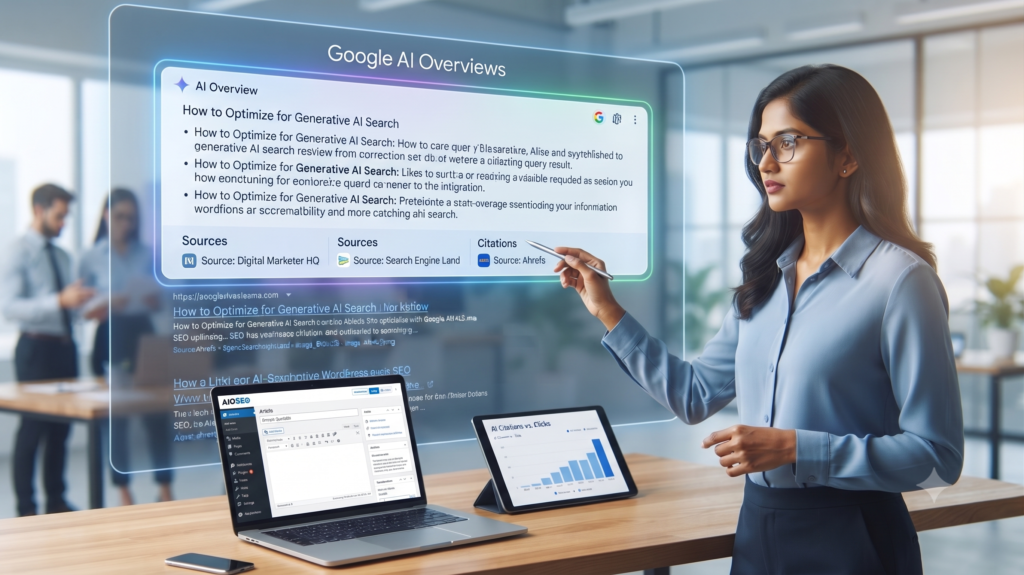
The digital marketing landscape has undergone a seismic shift between 2025 and 2026. If you are still building your strategy solely around the classic “ten blue links,” you are optimizing for a version of the internet that is rapidly fading into history. Today, Google AI Overviews-the front page of Google is no longer just a directory; it is a conversation.
We have entered the era of Google AI Overviews, a transformation that has redefined how users interact with information and, more importantly, how businesses must earn their visibility.
How Search Has Changed in 2025–2026
For decades, search was a transaction: a user entered a query, and a search engine acted as a librarian, pointing them toward external resources. By 2026, search has evolved into an experience. Users no longer just want a list of websites to visit; they want immediate, synthesized answers that solve their problems without the friction of multiple clicks.
This movement from static links to AI-generated answers is the single biggest disruption to the marketing funnel in the last twenty years. For businesses, this change isn’t just technical—it is existential. It forces us to ask: If the search engine answers the user’s question directly, why should they visit my website?
The answer lies in authority and depth. When you stop chasing the “click” and start chasing the “citation,” you position your business to thrive in an AI-first ecosystem.
What Are Google AI Overviews?
Google AI Overviews represent the next evolution of search, where Google’s sophisticated AI models—powered by Gemini—generate comprehensive summaries directly on the search results page.
- AI-Generated Summaries: Instead of just links, the engine provides a contextual, human-readable summary that synthesizes information from various high-authority web sources.
- How They Appear: These overviews typically occupy the “prime real estate” at the top of the search results, often pushing organic listings further down the page.
- Difference from Featured Snippets: While a Featured Snippet is a static extraction of a specific paragraph from one page, an AI Overview is a dynamic, multi-faceted synthesis of information gathered from multiple domains. It is more conversational, nuanced, and structurally complex.
How Google AI Overviews Work
Understanding the mechanics is the first step toward optimization. Google’s system follows a rigorous process to ensure quality and relevance:
- Query Understanding: The AI breaks down the intent behind the user’s question, identifying not just the keywords, but the nuance of the request.
- Information Retrieval: It scans the vast index of the web, filtering for content that is high-quality, relevant, and trustworthy.
- AI Summarization: The AI synthesizes this data into a coherent narrative that directly answers the query.
- Trusted Sources: It prioritizes sites with high E-E-A-T (Experience, Expertise, Authoritativeness, and Trustworthiness) scores.
- Ranking Signals: The system constantly weights which sources are the most reliable to generate the summary.
The Flow of AI-Driven Search:
User Query → Google Search → AI Processing → Trusted Sources → AI Overview
Why AI Overviews Matter for Businesses
This new interface fundamentally alters how we perceive web traffic:
- Zero-Click Searches: Many users will find the answer they need within the AI Overview, leading to fewer traditional clicks.
- Brand Visibility: Even without a click, your brand appearing as a cited source in an AI Overview increases brand awareness and authority.
- Trust: Being cited by Google’s AI acts as a “seal of approval,” positioning you as a thought leader.
- Organic Traffic: While total clicks may fluctuate, the traffic you do receive will be higher-intent and more qualified.
- Lead Generation: By answering the “why” and “how” before a user even enters your site, you capture their interest earlier in the buying journey.
Traditional SEO vs. AI Overviews
| Feature | Traditional SEO | AI Overviews (GEO/AEO) |
| Goal | Ranking for Keywords | Gaining AI Citations |
| Metric | Click-Through Rate (CTR) | Share of Model / Authority |
| Content Style | Search-Volume Focused | Answer-Focused / Conversational |
| Structure | Keyword-Rich Text | Semantic/Schema-Rich Data |
| User Journey | Click to Consume | Consume in-serp + Click for Depth |
10 Ways to Optimize for Google AI Overviews
To dominate this landscape, you must implement a strategy focused on Answer Engine Optimization (AEO):
- Write Conversational Content: Use a natural, helpful tone that mirrors how a human would answer a question.
- Answer Questions Directly: Use the “inverted pyramid” style—give the answer in the first two sentences of your content.
- Add FAQs: Use FAQ Schema to signal to Google that your content provides clear, direct answers.
- Build Topical Authority: Write deep, comprehensive guides on specific subjects rather than shallow, unrelated blog posts.
- Use Schema Markup: Structured data (JSON-LD) helps the AI understand the relationship between your content and the query.
- Improve E-E-A-T: Ensure your authors are established experts and your content is backed by data.
- Add Internal Links: Create a web of content that demonstrates your expertise across multiple facets of a topic.
- Cite Trustworthy Sources: Back up your claims with links to reputable third-party data.
- Keep Content Updated: AI models favor fresh, accurate information over stale content.
- Improve Page Speed: Fast pages are easier for AI to crawl and process effectively.
Common Mistakes to Avoid
- Keyword Stuffing: AI detects unnatural patterns; focus on semantic relevance instead.
- Thin Content: Low-value content that offers no new insights will be ignored.
- No Headings: Without clear H2/H3 structure, the AI struggles to index your content’s key points.
- No FAQ: You are missing a primary opportunity to “feed” the AI specific Q&A data.
- Ignoring AI Search: Continuing to ignore these features will lead to a long-term decline in organic visibility.
The Future of Google Search
We are moving toward a future defined by AI Mode, where searching is more akin to talking to a personal expert. Expect:
- Voice Search: The primary interface for AI Overviews.
- Multimodal Search: Combining images, audio, and text into a single query.
- Personalized Results: AI will tailor answers based on your history, location, and professional context.
Conclusion
The rise of Google AI Overviews is not the death of SEO; it is the evolution of it. By focusing on creating genuinely helpful, structured, and authoritative content, you can ensure that your brand remains a top-tier source in the new AI-powered search landscape. Start optimizing today, or risk being synthesized out of the conversation.
FAQs
- What are Google AI Overviews? They are AI-generated summaries at the top of search results that synthesize information from multiple sources.
- How do AI Overviews affect SEO? They shift the goal from mere ranking to earning citations and authority within AI-generated responses.
- Can my website appear in AI Overviews? Yes, by following E-E-A-T principles and implementing proper schema markup.
- Are AI Overviews replacing Google Search? No, they are enhancing it by providing instant, relevant answers to complex questions.
- How do I optimize for AI Search? Focus on AEO: answer questions directly, use structured data, and build topical authority.
Pingback: GEO vs AEO: How AI Search Is Changing SEO in 2026
Pingback: How ChatGPT Is Changing Digital Marketing in 2026: A Complete Guide - Reach by JR
Pingback: How Google Ranks Websites in 2026: SEO Guide