
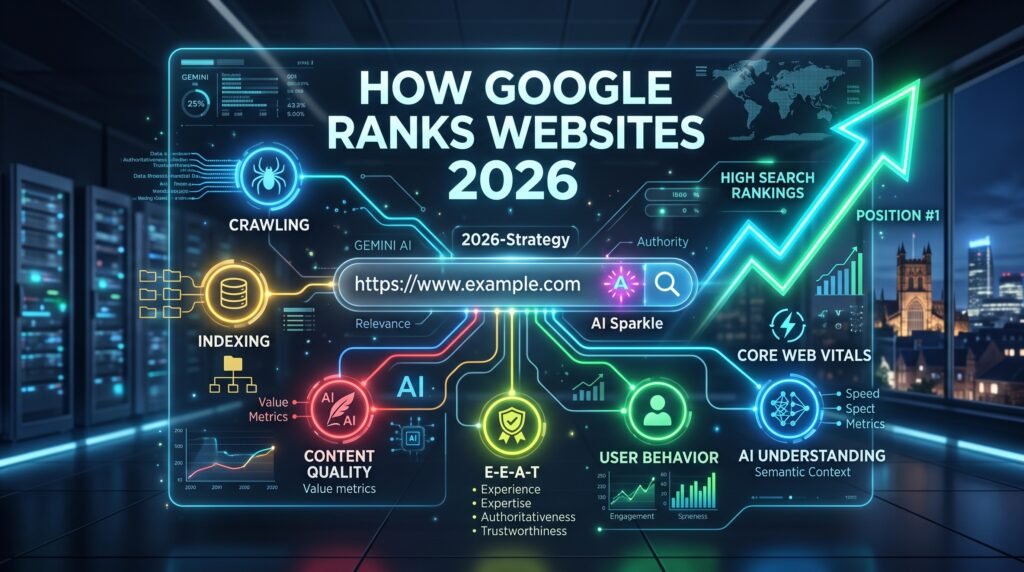
How Google ranks websites in 2026 is a question almost every SEO professional, business owner, and content creator eventually asks. But Google’s search results are not determined by a single secret ranking factor, an algorithmic loophole, or a static checklist. Google uses automated, interconnected systems designed to understand queries, discover and evaluate web pages, assess relevance and quality, and present useful results to users in real time.
Today’s search landscape is dynamic and multifaceted. When a user looks for information, they encounter:
- Traditional organic web listings
- Google AI Overviews synthesizing multi-source summaries
- Dedicated AI conversational search modes
- Complex, multi-part natural-language queries
- Mobile-first layouts with rich visual elements
- Short-form video, forums, and social discussions surfaced directly within Search
According to Google’s official Search Central documentation, modern SEO remains fundamentally relevant to generative AI search experiences because those features rely on Google’s core ranking and quality systems.
In this guide, I will break down how Google discovers, understands, and evaluates websites in 2026—and what digital marketers can practically do to build sustainable, long-term organic visibility.
How Does Google Rank Websites?
Google ranks websites by using automated Search systems that evaluate how relevant, reliable, and useful a page is for a particular query, while considering signals related to content depth, quality, user experience, links, technical accessibility, and broader web context.
The Misconception: Google Does Not Use a Single Fixed Checklist
A persistent myth in digital marketing is that Google evaluates web pages using an exact, immutable list of “200 ranking factors.”
In reality, Google deploys dozens of distinct algorithmic systems—such as helpful content systems, spam prevention models, and semantic language models—that evaluate different aspects of content and user intent. The weight of any individual signal varies significantly depending on the query context. For instance, the demand for up-to-the-minute freshness on breaking news queries carries far more weight than it does on a historical reference article.
How Google Search Works: From Crawling to Ranking
To rank content, Google must complete a multi-step pipeline before deciding which results to present to a user:
Discovery
↓
Crawling
↓
Rendering
↓
Indexing
↓
Understanding the Query
↓
Ranking
↓
Search Results / AI Search Features
1. Crawling
Crawling is the discovery phase. Automated software known as Googlebot navigates the open web to find new and updated content. Googlebot discovers URLs through:
- Internal and External Links: Following paths from already-known pages to discover new ones.
- XML Sitemaps: Reading structured files submitted by site owners via Google Search Console.
- Crawl Accessibility: Evaluating
robots.txtdirectives to confirm which sections of a site it is permitted to inspect.
2. Rendering and Indexing
Once crawled, Google parses the page’s HTML, runs associated JavaScript code (rendering), and analyzes the text, media, and structural data to understand what the page is about.
A crawled page is not guaranteed to be indexed. Google decides whether to index a page based on its perceived quality, technical directives (e.g., noindex tags), and duplicate content evaluations.
Note on Canonicalization: Google defines canonicalization as the process of selecting the authoritative, representative URL from a cluster of duplicate or substantially similar pages across the web.
3. Understanding Search Queries
Before matching content, Google’s language models analyze the searcher’s phrasing to decode:
- Search Intent: Is the user trying to buy, navigate, learn, or compare?
- Context & Semantics: Understanding synonyms, regional terminology, and conversational syntax.
- Language & Location: Serving geographically and linguistically appropriate solutions.
4. Ranking
Once Google understands the query, its ranking systems search the index for matching pages, ordering them based on relevance, content quality, site usability, and authority to deliver the best answer across standard listings and AI Overviews.
10 Key Factors That Influence Website Visibility in Google
Rather than chasing an arbitrary checklist of ranking tricks, modern SEO strategy focuses on ten core areas evaluated by Google’s systems:
1. Helpful, Original, and People-First Content
Google’s ranking systems prioritize content created primarily for humans rather than search engines. High-performing content provides:
- Original insights, data, or proprietary frameworks
- Direct, first-hand experience
- Clear solutions to user pain points
- A distinctive point of view that avoids generic summaries
2. Search Intent and Relevance
Keywords do not equal intent. A keyword phrase like “technical SEO” can indicate multiple conflicting needs:
| Possible Search Intent | Content Solution Required |
| Definitional | A concise definition of technical SEO |
| Educational | A comprehensive technical SEO beginner’s guide |
| Actionable | A downloadable technical audit checklist |
| Commercial | A comparison of technical SEO consulting services |
Aligning content with the specific problem the user is trying to solve determines whether Google considers your page relevant.
3. Content Quality and Expertise (E-E-A-T)
Google assesses the credibility of web content through the lens of E-E-A-T: Experience, Expertise, Authoritativeness, and Trustworthiness.
E-E-A-T is an evaluation concept detailed in Google’s Search Quality Rater Guidelines rather than a single numerical ranking metric. Demonstrating real-world testing, transparent author credentials, factual citations, and transparent publisher details signals that your content is safe and dependable.
4. Backlinks and Authority
Backlinks remain a fundamental component of search discovery. Google views natural, editorial links from relevant, industry-respected domains as third-party endorsements of your content’s accuracy. Chasing bulk, low-quality, or spammy link packages undermines trust and risks automated spam penalties.
5. Technical SEO
A website must be technically accessible for search engines to process its value. Critical technical baselines include:
- Clean crawl paths and configured
robots.txt - Proper XML sitemaps
- Appropriate canonical tags to prevent duplicate content issues
- Secure browsing via HTTPS
- Clean JavaScript rendering
(To build a solid foundation, read The Ultimate Beginner’s Guide to Technical SEO).
6. Page Experience and Core Web Vitals
Google evaluates technical user experience signals to ensure visitors have a frictionless experience. Core Web Vitals measure real-world performance metrics:
- Loading Speed (LCP): How fast primary content renders.
- Interactivity (INP): How quickly the page responds to user inputs.
- Visual Stability (CLS): Preventing elements from jumping around as assets load.
7. Internal Linking and Website Architecture
A logical site structure organizes your content into cohesive semantic clusters. Clear internal links using descriptive anchor text help Google’s bots map parent-child topic relationships, pass link equity, and index deep sub-pages.
(Learn how to organize your site in How to Build Content Clusters That Rank on Google and AI Search).
8. Structured Data and Search Understanding
Implementing Schema.org markup (such as Article, FAQ, Product, or Organization schema) provides explicit clues about the meaning of your content. While structured data does not guarantee higher rankings, it enables rich search results and helps search systems disambiguate entities.
9. Content Freshness Where It Matters
For topics that evolve rapidly—such as digital marketing workflows, artificial intelligence updates, software reviews, and breaking news—Google’s Query Deserved Freshness (QDF) systems prioritize pages that reflect current information and regular maintenance.
10. User and Search Behaviour
Search patterns are constantly shifting. Google monitors broad user interaction patterns across queries to determine if search results satisfy searchers or if users are immediately refining their searches, adjusting recommendations to match changing human demand.
How AI Is Changing Google Search in 2026
Google has expanded beyond standard keyword-matching into an interactive, multimodal discovery platform:
- Google AI Overviews: Generative answers synthesized at the top of results pages for complex, multi-layered queries.
- Conversational AI Mode: Enabling searchers to ask follow-up questions in natural, conversational language without restating the original context.
- Multimodal Search: Allowing users to search using combined inputs, such as taking a photo, highlighting an element, and adding a text question via Google Lens.
- Integrated Formats: Surfacing relevant discussions from forums, video platforms, and social channels directly alongside formal publications.
Google Search Console offers dedicated reporting capabilities that help webmasters evaluate how their content, videos, and brand assets appear across standard web results, Discover, and generative AI search features.
Does Traditional SEO Still Work in the AI Era?
Yes. Traditional SEO remains the prerequisite for modern search visibility.
AI-powered search features do not operate in a vacuum—they rely on Google’s established search index and core ranking systems to discover source materials.
Technical SEO (Accessibility & Indexing) + Quality Content (Original Insights & Depth) + Search Intent (Addressing Exact User Needs) + Topical Authority (Structured Topic Clusters) + Page Experience (Fast, Clean, Mobile-Friendly) + AI – Aware Content Strategy (Clear, Direct Information Extraction) = Modern Search Visibility
Without the fundamentals of crawlability, internal architecture, and editorial authority, generative engines cannot find, interpret, or cite your content.
(For an in-depth perspective, explore SEO Is Not Dead: Why It Matters More Than Ever in the AI Era).
How to Optimize a Website for Google Search in 2026
To establish consistent organic visibility, implement this 10-step strategic framework:
- Fix Technical Foundations: Audit your site with tools like Google Search Console and Screaming Frog to resolve 404 errors, crawl blocks, and redirect loops.
- Map True Search Intent: Analyze current search results for target terms to identify whether audiences want high-level summaries, tactical tutorials, or tool recommendations.
- Produce Comprehensive, Original Content: Incorporate unique perspectives, real-world examples, and data points that cannot be duplicated by simple automated prompts.
- Organize Topic Clusters: Build structured pillar pages supported by interconnected sub-topic articles to establish clear topical authority.
- Refine Internal Linking: Connect related resources using contextual, keyword-relevant anchor text.
- Demonstrate E-E-A-T: Showcase clear author bios, transparent business details, citations, and demonstrable domain expertise.
- Optimize Core Web Vitals: Minify CSS/JS, compress images, and maintain fast, reliable hosting performance.
- Earn Editorial Backlinks: Use digital PR, original research, and industry networking to attract high-value, natural links.
- Implement Schema Markup: Use structured data to help search systems understand entities, authors, and article types.
- Track Search Console Analytics: Monitor real-world clicks, impressions, average positions, and query shifts to continuously refine existing content.
How to Optimize Content for Google AI Search
Optimizing for generative search engines, Answer Engine Optimization (AEO), and Generative Engine Optimization (GEO) does not require tricks or keyword manipulation. Instead, format your content to be easily digested and cited by language models:
- Answer Core Questions Upfront: Place clear, concise summary answers immediately beneath subheadings before expanding into detailed analysis.
- Use Descriptive, Logical Headings: Structure your content hierarchy (H2s and H3s) as clear topic markers or explicit questions.
- Provide Original Context: Include unique commentary, case studies, or operational examples that set your page apart from generic web summaries.
- Structure Data Cleanly: Utilize bullet points, numbered process steps, and comparative tables to make extracted facts straightforward to parse.
- Establish Entity Relationships: Clearly define how your subject relates to broader industry concepts, tools, and practices.
- Cite Primary References: Attribute statistics, quotes, and research to original primary sources to reinforce content reliability.
SEO vs GEO vs AEO
Understanding how modern optimization methodologies fit together helps you allocate your marketing resources effectively:
| Strategy | Primary Objective | Target Platforms | Key Focus | Output Metric |
| SEO (Search Engine Optimization) | Indexation and ranking in organic results | Search engines (Google, Bing) | Crawlability, technical health, keywords, and links | Organic rankings, CTR, and website traffic |
| GEO (Generative Engine Optimization) | Inclusion and citation in generative AI summaries | AI Overviews, generative engines, LLMs | Contextual depth, entity clarity, and topical authority | Brand mentions, source citations, and referral traffic |
| AEO (Answer Engine Optimization) | Providing direct, extractable solutions to precise queries | AI chatbots, voice assistants, featured snippets | Q&A formatting, schema, and direct answer conciseness | Answer snippets, direct zero-click visibility |
(For a detailed breakdown of these distinct disciplines, see AI SEO vs Traditional SEO: What’s the Difference? and GEO vs AEO: The Complete Guide to Optimizing Your Website for AI Search).
Common SEO Mistakes to Avoid in 2026
When updating your search strategy, avoid these common tactical pitfalls:
- Keyword Stuffing: Artificially inserting repetitive keyword phrases disrupts readability and triggers quality-system demotions.
- Publishing Mass Unedited AI Content: Generating hundreds of surface-level articles without human review produces generic, low-value pages that dilute site quality.
- Ignoring User Intent: Creating content that fails to address what the searcher is actually trying to accomplish.
- Buying Manipulative Backlinks: Acquiring links from link networks violates Google Webmaster Guidelines and risks manual actions.
- Overlooking Technical Crawlability: High-quality writing cannot rank if indexing issues or server misconfigurations block Googlebot.
- Neglecting Existing Content: Allowing published guides to become outdated reduces search visibility over time.
- Focusing Exclusively on Traditional Keyword Ranks: Measuring success solely on isolated rank positions instead of organic conversions, brand discovery, and engagement gives an incomplete view of performance.
How to Measure Google SEO Performance
Accurate measurement requires monitoring multiple analytics channels:
Google Search Console
Google Search Console is the authoritative tool for monitoring search engine health. Track:
- Impressions & Clicks: Gauging overall visibility and click-through rates.
- Query Performance: Identifying which exact search terms surface your URLs.
- Index Coverage: Resolving crawl errors, canonical mismatches, and 404s.
- Core Web Vitals: Monitoring field data for real user performance.
Web Analytics Platforms
Analyze visitor behaviour after the click using tools like Google Analytics:
- Engaged Sessions: Monitoring average engagement time and bounce indicators.
- Key Conversions: Measuring lead generation, form submissions, and sales sourced from organic search.
- Top Landing Pages: Identifying which content assets drive the highest commercial value.
Professional SEO Audit Suites
Tools like Semrush, Ahrefs, and Screaming Frog provide competitive landscape analysis, backlink profile monitoring, broken link detection, and technical site health scores.
Frequently Asked Questions About How Google Ranks Websites
How does Google rank websites?
Google discovers web pages via crawling, processes their content during indexing, and uses automated ranking systems to evaluate relevance, content quality, page speed, technical usability, and authority before ordering results for a search query.
What are Google’s most important ranking factors?
There is no single primary ranking factor. Google evaluates a combination of signals, with the most critical being search intent match, helpful and original content, technical crawlability, page user experience, and authoritative backlinks.
Does Google use AI to rank websites?
Yes. Google uses artificial intelligence and machine learning models (such as RankBrain and modern natural language processing models) to interpret the context of search queries, understand language nuances, and evaluate content relevance.
Does SEO still work in 2026?
Yes. Search engine optimization remains the core method for ensuring your website is technically accessible, understandable, and authoritative enough for traditional search engines and AI experiences to discover and reference.
How long does it take to rank on Google?
For new websites, building sufficient authority and index history typically takes anywhere from 3 to 6 months of consistent publishing and optimization. Established websites with high topical authority can rank new content within days or hours.
Does AI-generated content rank on Google?
Yes. Google evaluates content based on its utility, quality, accuracy, and relevance rather than how it was produced. However, unedited, generic AI-generated content often struggles to rank because it lacks original perspective and first-hand experience.
Do backlinks still matter?
Yes. Backlinks remain one of the most reliable indicators of domain trust and authority. Google considers natural, editorial links from reputable websites as votes of confidence in your content’s credibility.
How can I improve my Google rankings?
Focus on resolving technical errors, organizing content around comprehensive topic clusters, addressing search intent directly, updating stale pages, and earning high-quality industry backlinks.
Does technical SEO affect rankings?
Yes. If search engine crawlers face indexing barriers, broken canonical tags, or slow server response times, they cannot effectively crawl or rank your web pages regardless of content quality.
How does Google AI search affect SEO?
Google AI search features, like AI Overviews, provide synthesized answers for complex queries. This shifts optimization toward answering conversational questions clearly, structuring data cleanly, and building authority so your brand is cited as a trusted source.
Final Thoughts — How Google Ranks Websites in 2026
How Google ranks websites in 2026 cannot be reduced to a secret trick or a fixed checklist. Sustainable SEO is built on making your website technically accessible, precisely aligned with search intent, genuinely useful, trustworthy, and simple for search systems to interpret.
The core principles of search have not disappeared—they have evolved. Digital marketers and business owners must now balance traditional search technicals with an understanding of conversational queries, multimodal inputs, and AI-driven answer engines.
The future of organic visibility belongs to professionals who can combine strong technical foundations with original, people-first content and strategic adaptability.
Explore Related SEO & AI Strategy Guides:
- SEO Is Not Dead: Why It Matters More Than Ever in the AI Era
- AI SEO vs Traditional SEO: What’s the Difference?
- The Ultimate Beginner’s Guide to Technical SEO
- How to Build Content Clusters That Rank on Google and AI Search
- GEO vs AEO: The Complete Guide to Optimizing Your Website for AI Search
- Google AI Overviews Explained
- How ChatGPT Is Changing Digital Marketing in 2026
- Content Marketing in 2026: Strategies That Actually Work
About the Author
Jayasri Remma is a Digital Marketing Professional specializing in SEO, technical SEO, content strategy, AI-powered search, GEO, and AEO. Through her website, she shares practical insights into modern search systems, digital marketing execution, and the evolving role of artificial intelligence in building online visibility.