
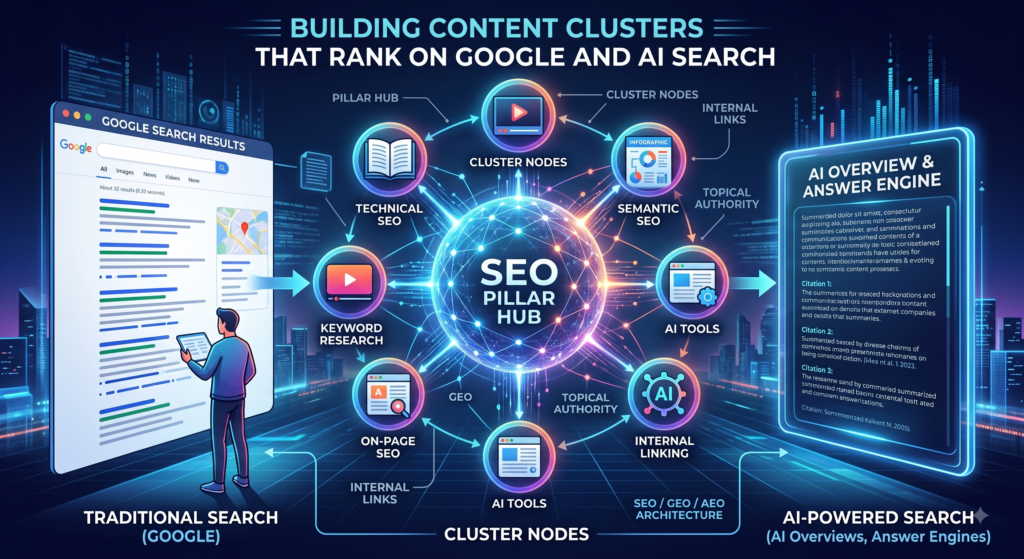
Content clusters can turn a collection of individual blog posts into a strategic SEO ecosystem. Instead of publishing articles about unrelated keywords every week, a content cluster connects multiple pieces of content around one broad topic, Consequently, this helps your helping readers—and search engines—understand your expertise.
To picture this, Imagine two websites trying to grow their organic traffic.
First, website A publishes 50 random articles covering a wide variety of topics:
- Email marketing
- Instagram trends
- SEO
- Google Ads
- AI tools
- Website design
On the other hand, Website B, on the other hand, focuses deeply on a single overarching theme—SEO—and publishes interconnected content around:
- Technical SEO
- On-page SEO
- Keyword research
- Internal linking
- Content clusters
- Semantic SEO
- AI search
- GEO
- AEO
Therefore, which website demonstrates stronger topical authority to a search engine?
If you guessed Website B, you are correct. By creating an organized web of information, Website B signals to search algorithms that it is a comprehensive, trustworthy resource on search engine optimization.
In this guide, we are going to explore exactly how to research, plan, create, interlink, optimize, and measure a content cluster strategy that dominates traditional search engines and positions your brand for the new era of AI search.
What Are Content Clusters?
To put it simply, Content clusters are groups of interconnected web pages that cover different aspects of a broader topic and link back to a central pillar page.
Instead of treating your website like a chaotic filing cabinet, a cluster strategy organizes your content into neat, highly relevant folders. Typically, this structure typically consists of three core components:
Pillar Page
First and foremost, the pillar page is the comprehensive guide covering the main, broad topic. It acts as the hub of your cluster. It broadly touches on every aspect of the subject but leaves the deep, granular details for the supporting articles.
Cluster Content
Next, These are the supporting articles covering specific subtopics in detail. For example, If your pillar page is about “SEO,” your cluster content includes deep-dives into “How to do keyword research” or “How to optimize images.”
Internal Links
Finally, Internal links are the invisible threads connecting the pillar and supporting pages. Every cluster article links back to the main pillar page, and the pillar page links out to every cluster article.
Here is a simple visual flow of a content cluster:
Pillar Page: SEO↓
Technical SEO↓
Keyword Research↓
On-Page SEO↓
Internal Linking↓
Content Clusters↓
AI SEO
Why Content Clusters Matter for SEO
The transition from keyword-stuffed blog posts to organized content clusters is one of the most important shifts in modern SEO. Here is exactly why this strategy works so well.
Build Topical Authority
Google wants to rank experts. By covering every conceivable angle of a specific subject, you show search engines that your website isn’t just targeting a keyword—it covers the subject comprehensively. As a result, This deep, interconnected coverage builds “topical authority,” making it easier to rank for competitive terms.
Improve Internal Linking
Links distribute relevance and authority (often called “link juice”) across your website. For instance, When a high-performing cluster article earns a backlink, the internal links pass that authority to the pillar page and the other connected articles. Furthermore, It also helps users seamlessly navigate related information, keeping them on your site longer.
Target Multiple Search Intents
One broad topic can capture users at very different stages of the buyer’s journey. Therefore, A strong cluster allows you to target:
- Informational intent: “What is SEO?”
- Commercial intent: “Best SEO tools for beginners”
- Navigational intent: “Semrush pricing”
- Transactional intent: “Hire an SEO agency”
Increase Organic Visibility
Ultimately, A strong cluster gives you opportunities to rank for dozens, if not hundreds, of related queries rather than relying on one single “golden” keyword. Because the cluster ranks collectively, your overall organic visibility skyrockets.
Why Content Clusters Matter for Google AI Search
Meanwhile, The search landscape is shifting dramatically. With the rise of Google AI Overviews, ChatGPT, Gemini, and Perplexity, search engines are acting more like answer engines.
A well-organized content cluster can make a website’s subject coverage and relationships between topics clearer to search systems. Consequently, this can support visibility across traditional and AI-powered search, although no content structure guarantees inclusion in an AI-generated answer.
By mapping out entities (people, places, concepts) and clearly defining the semantic relationships between them through a cluster, you feed AI models the structured, context-rich data they crave. When an AI model looks for a definitive source to synthesize an answer, a deeply linked, highly authoritative content cluster is far more attractive than an isolated, standalone blog post.
Content Clusters, GEO and AEO: What’s the Connection?
If you are following the latest digital marketing trends, you have likely heard of GEO and AEO. Here is how they all connect through the power of content clusters:
- SEO (Search Engine Optimization): Optimizes content for search visibility, ensuring crawlers can find and index your site.
- GEO (Generative Engine Optimization): Focuses on making content understandable, authoritative, and useful for generative AI experiences.
- AEO (Answer Engine Optimization): Focuses on answering specific questions clearly to capture AI snippets and conversational queries.
- Content Clusters: Create the underlying information architecture that connects all of these efforts.
In short, Clusters provide the structure, SEO provides the technical foundation, and GEO/AEO dictate how the content is formatted to win in 2026.
👉 Read our complete guide on GEO vs AEO here to dive deeper into these concepts.
How to Build a Content Cluster Step by Step
Building a successful cluster requires strategy, research, and execution. Therefore, follow these 10 steps to build an ecosystem that ranks.
Step 1 — Choose a Broad Topic
First, Choose a core topic that is broad enough to support multiple subtopics but specific enough to be relevant to your business. Ideally, It should have sufficient search demand, match your target audience’s pain points, and support your ultimate business goals.
Example: Instead of choosing a narrow topic like “SEO meta descriptions,” choose a broad topic like “SEO.” From there, you can build dozens of subtopics underneath it.
Step 2 — Create Your Pillar Page
Secondly, Your pillar page is the ultimate resource on your chosen topic. It should contain a comprehensive overview of the subject, broken down into clear, scannable sections. Additionally, It must include links to your supporting articles, original examples, FAQs, expert insights, and regularly updated information to maintain its authority.
Step 3 — Find Cluster Topics
Next, Don’t guess what your audience wants to know—use data. Generate your supporting topics using a mix of tools:
- Google Search (Autocomplete and Related Searches)
- Google Search Console
- Google Keyword Planner
- Semrush or Ahrefs
- “People Also Ask” boxes
- Reddit discussions and Quora
- Competitor research
- AI brainstorming (ChatGPT or Gemini)
Important: While AI can help generate ideas rapidly, but you must validate those topics using actual search and audience data.
Step 4 — Map Search Intent
Before writing, map your cluster topics to the correct search intent. Consequently, this ensures you are guiding the user smoothly down the funnel.
| Topic | Search Intent | Content Type |
| What is SEO? | Informational | Pillar Guide / Definition |
| How to do keyword research | Informational | Step-by-Step Tutorial |
| Best SEO tools | Commercial | Listicle / Comparison |
| SEO agency | Transactional | Service Page |
Step 5 — Create Helpful Cluster Content
Subsequently, Every supporting article should answer a specific question rather than simply repeating what is on the pillar page. Dive deep. Provide unique examples, proprietary data, and step-by-step instructions. Above all, each article must add something genuinely new to the internet.
Step 6 — Connect Everything with Internal Links
This is the magic step. Without links, you just have a bunch of random articles. You must connect them strategically:
- Pillar → Cluster: Link from the broad sections of your pillar page to the detailed cluster articles.
- Cluster → Pillar: Ensure every subtopic article links back to the main pillar page using descriptive anchor text.
- Cluster → Related Cluster: Link laterally between supporting articles when relevant to keep users moving through your site.
Step 7 — Optimize Each Page for SEO
Every page in your cluster needs foundational SEO optimization. Ensure you optimize the:
- Title tag and H1
- H2/H3 subheadings
- Meta description
- URL slug (keep it clean)
- Internal and external links
- Image alt text
- Schema markup
- Search intent matching
- Readability and formatting
Step 8 — Optimize for GEO and AEO
Furthermore, To capture Google AI Overviews, format your cluster content for machines and humans alike. Include direct answers (40-60 words) immediately after question-based headings. Use clear definitions, FAQ sections, structured tables, original insights, and cite reliable sources to clarify your entity relationships to AI models.
Step 9 — Publish Consistently
Interestingly, A content cluster does not need to be published all at once. In fact, dripping it out shows search engines that your site is consistently updated.
- Month 1: Publish the Pillar + 3 supporting articles.
- Month 2: Add 4 more cluster articles.
- Month 3: Add 4 more cluster articles and update the pillar page with new links.
Step 10 — Measure and Improve
Finally, Use Google Search Console and analytics software to track your cluster’s performance. Monitor organic clicks, impressions, rankings, CTR, and conversions. Most importantly, Pay close attention to internal-link performance and user engagement metrics to identify pages that need a content refresh.
Example of a Content Cluster
To make this tangible, let’s look at how I structure the SEO content ecosystem right here on this website.
Pillar Page:
- The Complete Guide to SEO
Supporting Cluster Articles:
- The Ultimate Beginner’s Guide to Technical SEO
- Keyword Research Guide
- On-Page SEO Best Practices
- Off-Page SEO Strategies
- Internal Linking Masterclass
- How to Build Content Clusters That Rank (You are reading this now!)
- Semantic SEO
- Local SEO
- SEO Is Not Dead: Why It Matters More Than Ever in the AI Era
By interlinking these articles, I signal to search engines that my website is a comprehensive hub for digital marketing and SEO education.
Content Cluster vs Traditional Blogging
Why go through all this effort? Let’s compare the modern cluster approach to the old way of doing things.
| Traditional Blogging | Content Cluster Strategy |
| Random topics | Connected topics |
| Keyword-focused | Topic-focused |
| Individual articles | Content ecosystem |
| Limited internal links | Strategic internal linking |
| Short-term approach | Long-term authority |
| Ranks for one keyword | Ranks for multiple related queries |
Traditional blogging isn’t necessarily wrong—however, it simply becomes exponentially more powerful when supported by a strategic, interconnected architecture.
Common Content Cluster Mistakes
Even experienced marketers can stumble when building clusters. Avoid these common pitfalls:
- Publishing unrelated topics: Sticking a recipe on a digital marketing blog dilutes your authority.
- Creating duplicate cluster content: Writing three articles that answer the exact same intent causes keyword cannibalization.
- Overusing exact-match keywords: Forcing unnatural keywords ruins the user experience.
- Poor internal linking: Forgetting to link your new cluster articles back to the pillar page.
- Making every article the same length: A simple definition might need 800 words; a technical tutorial might need 3,000. Let intent dictate length.
- Ignoring search intent: Writing a 2,000-word educational guide when the user just wants to buy a product.
- Creating content just for volume: Quality always beats quantity in the AI era.
- Never updating old content: Evergreen clusters require routine maintenance.
- Using AI to produce generic articles at scale: Generating hundreds of soulless AI articles will actively harm your brand’s trust and E-E-A-T.
How to Measure the Success of a Content Cluster
Traffic alone isn’t the ultimate KPI. To genuinely understand if your cluster is truly working, you need a holistic measurement framework:
Visibility
- Impressions: Are your pages showing up in search results?
- Rankings: Are your targeted keywords moving up the SERPs?
- Organic Clicks: Are people actually clicking on your links?
Engagement
- Time Engaged: Are readers staying on the page to consume the content?
- Pages per Session: Are users clicking your internal links to read the rest of the cluster?
- Returning Users: Does your content establish enough trust to bring people back?
Business
- Leads: Is the cluster capturing emails or subscribers?
- Enquiries: Are readers reaching out for your services?
- Conversions: Is the cluster directly driving revenue or sales?
Authority
- Number of Ranking Keywords: Is your cluster picking up hundreds of long-tail semantic keywords?
- Backlinks: Are other websites citing your pillar page as a resource?
- Brand Mentions: Are people talking about your brand in relation to this topic?
Frequently Asked Questions About Content Clusters
What is a content cluster?
A content cluster is an SEO strategy where multiple related articles (cluster content) are grouped together and linked to a central, comprehensive hub (the pillar page).
How do content clusters improve SEO?
They improve SEO by building topical authority, improving internal link architecture, keeping users on the site longer, and helping search engine bots crawl and index pages more efficiently.
What is a pillar page?
A pillar page is a long-form, comprehensive piece of content that covers all aspects of a broad topic and links out to more detailed cluster articles.
How many articles should a content cluster have?
There is no strict rule, but a solid cluster typically starts with one pillar page and 5 to 15 supporting cluster articles, depending on the complexity of the topic.
Are content clusters still relevant for AI search?
Yes, absolutely. By organizing information clearly and establishing semantic relationships, clusters provide the structured data that AI models and generative engines rely on to synthesize answers.
What is the difference between a content cluster and a topic cluster?
Nothing; these terms are used interchangeably in the SEO and digital marketing industry.
How do I create a content cluster?
Choose a broad topic, write a comprehensive pillar page, research specific subtopic keywords, write dedicated articles for those subtopics, and interlink them all together.
How long does it take for a content cluster to rank?
Like all SEO strategies, it takes time. Depending on your domain authority and the competitiveness of the niche, it typically takes 3 to 6 months to see significant momentum from a new content cluster.
Final Thoughts
Content clusters are more than an SEO technique—they are a way to build a structured knowledge ecosystem around the topics your audience actually cares about.
Ultimately, The future of SEO isn’t simply about publishing more content. It’s about creating connected, useful, authoritative resources that help people find the right information at the right stage of their journey. As search engines evolve with AI, they will increasingly reward websites that act as organized, deep libraries of expertise rather than scattered collections of random thoughts.
Whether you’re building a business website, growing a personal brand, or developing an enterprise SEO strategy, start thinking beyond individual blog posts. Build a content ecosystem.
Explore more SEO insights →
Expand your digital marketing knowledge by exploring the rest of our content ecosystem:
- SEO Is Not Dead: Why It Matters More Than Ever in the AI Era
- The Ultimate Beginner’s Guide to Technical SEO
- GEO vs AEO: The Complete Guide to AI Search
- Google AI Overviews Explained
- How ChatGPT Is Changing Digital Marketing in 2026
- Content Marketing in 2026: 12 Proven Strategies That Actually Work
- 10 AI Marketing Tools Every Digital Marketer Should Use
About the Author
Jayasri Remma is a Digital Marketing Professional specializing in SEO, content strategy, Social Media, AI-powered search, GEO, AEO, and digital marketing. Through her website, she shares practical SEO strategies, industry insights, and experiments exploring how search is evolving in the AI era.
Pingback: How Google Ranks Websites in 2026: SEO Guide