
AI SEO vs traditional SEO is becoming one of the most important conversations in digital marketing as artificial intelligence changes how people discover information online.
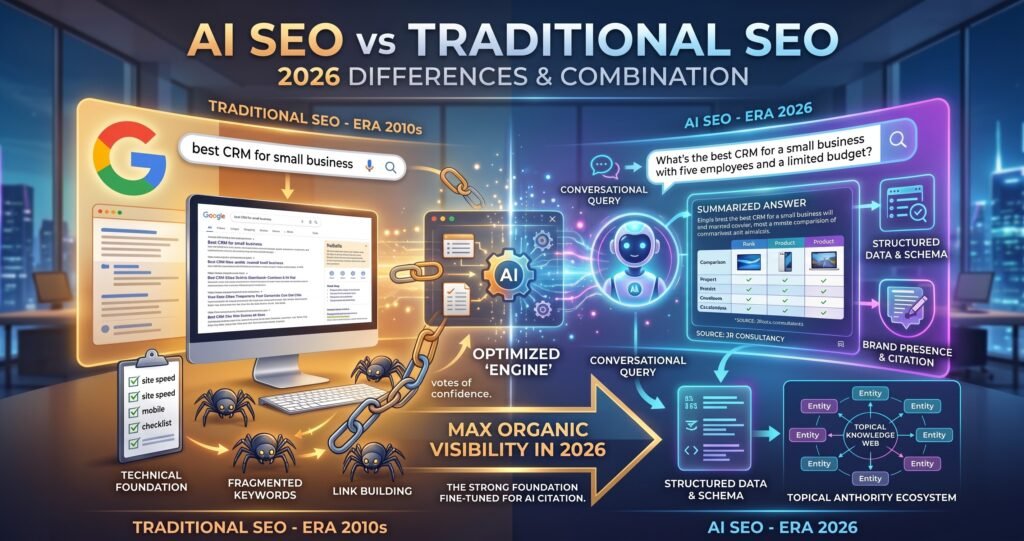
Imagine someone is looking for software to manage their growing sales team.
In a traditional search scenario, they might type a fragmented keyword phrase into Google:“best CRM for small business”
In response, they see a familiar page layout: organic search results, paid advertisements, product pages, and perhaps a featured snippet.
Now, imagine that same person opening an AI assistant or a generative search engine. Because they can talk to it naturally, their query looks completely different:
“What’s the best CRM for a small business with five employees and a limited budget?”
The AI doesn’t just hand them a list of ten blue links. Instead, it provides one summarized answer, compares several options based on their specific constraints, and cites selected sources to back up its recommendations.
That creates a completely different challenge for marketers and business owners.
The question is no longer only: How can I rank my webpage?
It is increasingly also: How can my content become useful enough to be included in AI-powered answers?
In this comprehensive guide, we are going to break down exactly what you need to know. You will learn what AI SEO means, what traditional SEO means, the main differences between the two, what fundamentals remain exactly the same, and how modern businesses should combine both approaches for maximum visibility in 2026.
What Is Traditional SEO?
Traditional SEO is the process of improving a website’s visibility in search engine results through technical optimization, relevant content, keyword research, links, and user experience.
It is the foundational playbook digital marketers have used for two decades to help search engines like Google crawl, index, and rank web pages. The core areas of traditional SEO include:
Keyword Research
Finding out exactly what terms your target audience is typing into search engines, evaluating the search volume, and determining the ranking difficulty. It’s about matching your website’s content to the specific language your customers use.
On-Page SEO
Optimizing individual web pages so they rank higher. This includes crafting compelling title tags, writing descriptive meta descriptions, structuring headers (H1, H2, H3) logically, and naturally integrating primary and secondary keywords into the body content.
Technical SEO
Ensuring search engine bots can easily access, crawl, and index your website. This involves optimizing site speed, ensuring mobile responsiveness, fixing broken links, and maintaining a clean XML sitemap. (You can dive deeper into this in our Ultimate Beginner’s Guide to Technical SEO).
Content Creation
Publishing blog posts, landing pages, and resources that address the user’s search intent. In traditional SEO, the goal is often to create the most comprehensive piece of content on a specific keyword topic.
Link Building and Authority
Earning backlinks from other reputable websites. Traditional search algorithms treat these links as “votes of confidence,” signaling that your content is trustworthy and authoritative.
User Experience
Ensuring that once a user clicks on your search result, they have a positive experience. Core Web Vitals, intuitive navigation, and clear calls-to-action all play a role in keeping visitors engaged and signaling to search engines that your site provides value.
What Is AI SEO?
AI SEO is an evolving approach to search optimization that considers how AI-powered search experiences retrieve, understand, summarize, and present information alongside traditional search results.
As search engines integrate large language models (LLMs) to generate direct answers—such as Google’s AI Overviews or platforms like ChatGPT and Perplexity—optimizing for search requires a broader perspective.
AI SEO may involve:
- Semantic relevance: Focusing on the meaning behind words rather than just the words themselves.
- Clear entity relationships: Helping AI understand the connections between people, places, concepts, and your brand.
- Conversational queries: Optimizing for long, highly specific, natural-language questions.
- Direct answers: Formatting content so that facts and definitions can be easily extracted by AI.
- Structured content: Using tables, lists, and clear headers to make information easily digestible for machine learning models.
- Topical authority: Covering a subject so thoroughly that AI recognizes your site as a definitive source.
- Trustworthy information: Building strong brand credibility, as AI systems prefer citing highly trusted sources.
- GEO and AEO principles: Applying Generative Engine Optimization and Answer Engine Optimization techniques.
Important positioning: Avoid presenting AI SEO as a completely separate replacement for SEO.
AI SEO builds upon strong SEO foundations. A website that search systems cannot crawl, understand, or trust is unlikely to benefit simply by adding AI-focused tactics. If your technical SEO is broken, an AI bot cannot read your content to summarize it. Traditional SEO is the engine; AI SEO is fine-tuning that engine for a new type of road.
AI SEO vs Traditional SEO: The Key Differences
To understand how your strategy needs to adapt, it helps to look at the differences side-by-side.
| Area | Traditional SEO | AI SEO |
| Main goal | Visibility in traditional search results | Visibility across AI-assisted search experiences |
| Queries | Keywords and fragmented search terms | Natural-language and conversational queries |
| Content | Keyword-optimized web pages | Context-rich, easily extractable information |
| Focus | Rankings, search volume, and traffic | Answers, visibility, citations, and brand presence |
| Optimization | Keywords, backlinks, and technical SEO | SEO foundations plus semantics, entities, and direct answers |
| User journey | Search → Click → Website | Question → AI answer → Source/brand discovery |
| Measurement | Rankings, clicks, and Click-Through Rate (CTR) | Traditional metrics plus AI visibility (where measurable) |
AI SEO vs traditional SEO should not be viewed as a choice between two competing strategies. Traditional SEO provides the technical and structural foundation, while AI-focused optimization helps marketers adapt to the new ways people search and consume information. They are two halves of a modern organic growth strategy.
How Search Behaviour Is Changing From Keywords to Conversations
The way we talk to machines has changed. We are no longer limited to “caveman speak” to get results.
Traditional search:
“technical SEO checklist”
Conversational AI query:
“Can you give me a beginner-friendly technical SEO checklist for a WordPress website?”
Notice the difference? Conversational queries provide:
- More context: The user specifies their skill level (“beginner-friendly”).
- Specific requirements: The user mentions their exact platform (“WordPress”).
- Natural language: The phrasing mimics human conversation.
- Multiple questions in one request: Users often stack constraints, forcing the AI to synthesize a custom answer.
This is where understanding search intent becomes hyper-critical. Understanding the user’s actual underlying problem is far more important than repeating exact-match keywords across your page.
AI SEO vs Traditional SEO for Content Strategy
The way we plan and create content is shifting to accommodate both traditional algorithms and generative engines.
Traditional SEO Content
Historically, planning an SEO content calendar often focuses on:
- The primary target keyword.
- Monthly search volume.
- Ranking difficulty and competitor metrics.
- SERP (Search Engine Results Page) analysis to match the exact format of the top 10 results.
AI SEO Content
A modern content strategy must also consider:
- The hyper-specific, multi-part questions users ask.
- The broader context surrounding a topic.
- Entities and relationships (how your topic connects to broader industry concepts).
- Concise, extractable definitions.
- Direct answers placed immediately after headings.
- Supporting evidence and original data.
- Topical depth rather than just word count.
- The key takeaway the user needs immediately.
A note on execution: AI optimization should not mean generating hundreds of mediocre articles with AI. Instead, use AI tools to improve your research, streamline your workflows, and boost your productivity, while adding human expertise, original examples, and real strategic insight to the final piece.
Why Topical Authority Matters in AI SEO and Traditional SEO
A single article boldly stating you are an SEO expert is not enough to convince Google, nor is it enough to convince an AI language model. You need to build a web of interconnected relevance.
A stronger website contains logically connected resources. Think of it as a knowledge ecosystem:
SEO Pilla
- Technical SEO
- Keyword Research
- On-Page SEO
- Internal Linking
- Content Clusters
- GEO (Generative Engine Optimization)
- AEO (Answer Engine Optimization)
- AI SEO
- Google AI Overviews
By thoroughly covering every subtopic within your niche, you create a clearer knowledge ecosystem for both users and search systems. When an AI needs to synthesize an answer about digital marketing, it will pull from the domain that demonstrates the deepest, most comprehensive expertise.
(Learn more in our guide on How to Build Content Clusters That Rank on Google and AI Search).
The Role of GEO and AEO in AI SEO
As you dive into AI SEO, you will inevitably encounter two critical acronyms: GEO and AEO. Understanding how they interact with traditional SEO is key to your success in 2026.
GEO — Generative Engine Optimization
GEO focuses on making your content useful, contextual, and understandable for generative AI search experiences. It involves structuring data, utilizing entities, and ensuring your brand is mentioned in association with key industry concepts so that AI models naturally cite you as a source.
AEO — Answer Engine Optimization
AEO is a subset of GEO that focuses specifically on providing clear, concise, and direct answers to specific user questions. It’s about formatting your content (often using Q&A formats or definition blocks) so that a voice assistant or AI snippet can extract the exact answer effortlessly.
SEO — Search Engine Optimization
SEO remains the bedrock. It is responsible for discoverability, crawling, indexing, site structure, content relevance, and domain authority.
The Connection: SEO helps people and search systems find and access your content. GEO helps you think about how that content may be synthesized and used in generative experiences, while AEO focuses on answering the user’s questions as clearly as possible within that content.
(For a deeper dive, check out our cornerstone article: GEO vs AEO: The Complete Guide to Optimizing Your Website for AI Search).
7 AI SEO Strategies That Still Depend on Traditional SEO
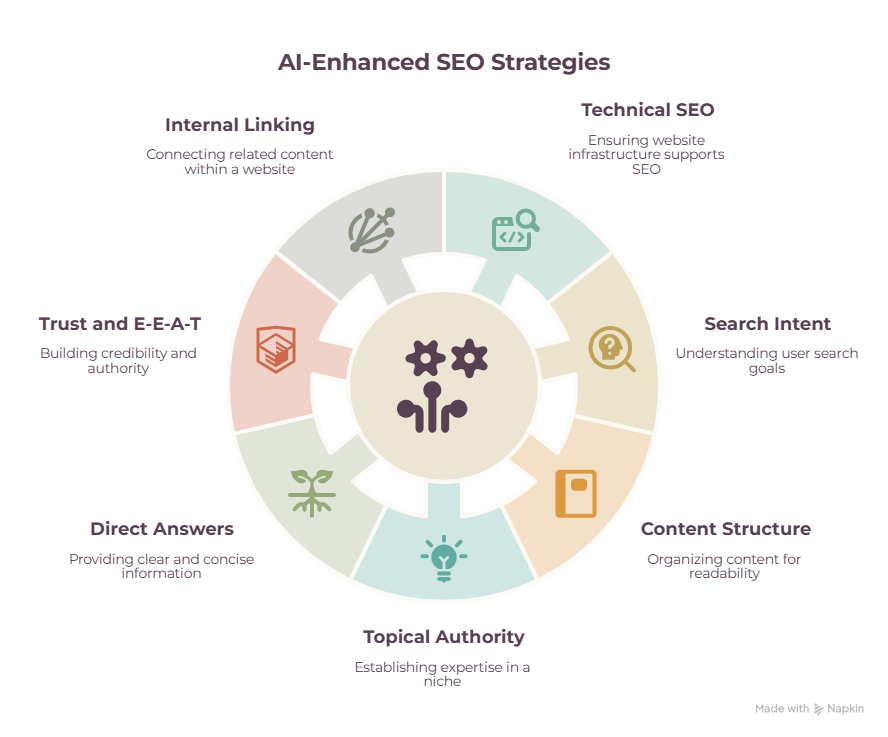
If you are an SEO Lead or marketing manager, integrating these approaches is the most valuable thing you can do for your brand in 2026.
1. Start With Strong Technical SEO
AI cannot cite what it cannot read. You must ensure your site is technically sound. Focus on crawlability, indexability, site speed, mobile usability, and maintaining clean XML sitemaps.
2. Understand Search Intent
Whether a user types three words into Google or speaks a paragraph to ChatGPT, they want to solve a problem. Aligning your page with the user’s actual intent (Informational, Navigational, Commercial, or Transactional) is non-negotiable.
3. Create Clear and Structured Content
AI models love structure. Break up walls of text. Use descriptive headings, short paragraphs, bulleted lists, comparison tables, and bolded definitions. The easier a page is to scan for a human, the easier it is to parse for an AI.
4. Answer Important Questions Directly
Don’t bury the answer under 500 words of fluff. If a heading asks a question, the very next sentence should provide a clear, concise answer. You can expand on the details in the subsequent paragraphs.
5. Build Topical Authority
Publish comprehensive content clusters rather than isolated blog posts. Prove to search engines that your domain is the ultimate resource for your specific industry.
6. Strengthen Trust and E-E-A-T
Experience, Expertise, Authoritativeness, and Trustworthiness (E-E-A-T) are more vital than ever. AI models hallucinate, so search engines prioritize citing trusted sources to mitigate risk. Showcase real experience, include detailed author information, ensure absolute accuracy, cite your sources appropriately, and perform regular content updates.
7. Build a Strong Internal Linking Strategy
Connect related pages logically using descriptive anchor text. Internal linking helps AI and traditional crawlers understand the hierarchy and relationship between the different concepts on your website.
AI SEO vs Traditional SEO: What Still Matters Most?
With the rise of AI Overviews, Perplexity, and ChatGPT, it’s easy to panic and assume the old rules are dead. They aren’t.
The fundamentals still matter immensely:
- Helpful, human-centric content
- Relevant, accurate information
- Technical accessibility
- Frictionless user experience
- Domain authority
- Brand trust
- Clear site architecture
The technology behind search is changing, but the core goal remains surprisingly consistent: help users find useful, reliable information.
Common Mistakes When Adapting to AI SEO
As the industry pivots, many marketers are making critical unforced errors. Avoid these common traps:
Believing Traditional SEO Is Dead
Abandoning your technical foundation and backlink strategy to focus purely on “AI prompts” will cause your organic traffic to plummet. AI search relies on the traditional search index.
Publishing Unedited AI Content at Scale
Using AI to write thousands of generic blog posts will bloat your site, dilute your topical authority, and likely trigger a spam penalty.
Chasing Every New AI Trend
The AI landscape shifts weekly. Focus on the foundational shifts (semantic search, user intent, E-E-A-T) rather than rewriting your entire strategy for a minor feature update.
Ignoring Technical SEO
A fast, crawlable, well-structured website is a prerequisite for both traditional ranking and AI citation.
Keyword Stuffing for AI
Repeating keywords didn’t work for Google in 2016, and it certainly won’t help an advanced LLM understand your content in 2026. Focus on context and natural language.
Creating Generic Content With No Original Insight
If your content just summarizes what is already on the internet, an AI has no reason to cite you. You must provide original data, personal experience, or unique strategic frameworks.
Measuring Only Rankings
A modern SEO strategy should consider organic traffic, on-page engagement, conversions, and broader brand visibility (like brand mentions in AI outputs)—not traditional 1-to-10 rankings alone.
How to Build an SEO Strategy for the AI Era
Ready to adapt? Here is a practical framework you can implement today to future-proof your digital marketing strategy:
Step 1: Fix the Technical Foundation. Audit your site speed, fix broken links, and ensure mobile parity.
Step 2: Understand Your Audience and Search Intent. Talk to sales and customer service to find out what hyper-specific questions your customers are actually asking.
Step 3: Build Topic Clusters. Map out your core topics and create a hub-and-spoke content model.
Step 4: Create Helpful, Original Content. Inject unique data, case studies, and real human experience into every piece you publish.
Step 5: Optimize Important Questions for Clear Answers. Use AEO principles to provide succinct definitions and direct answers immediately under your subheadings.
Step 6: Strengthen Internal Linking. Tie your topic clusters together so bots understand your site’s semantic relationships.
Step 7: Demonstrate Expertise and Trust. Build out your “About Us” page, use author bios, and earn high-quality backlinks from reputable industry publications.
Step 8: Monitor Performance and Update Your Strategy. Look beyond standard rank tracking. Monitor your referral traffic, brand search volume, and overall organic conversions.
Frequently Asked Questions About AI SEO vs Traditional SEO
Is AI SEO replacing traditional SEO?
No, AI SEO is an evolution, not a replacement. Traditional SEO provides the essential foundation—like crawlability and site structure—while AI SEO adapts your content strategy for conversational queries, semantic relevance, and AI-generated direct answers.
What is the main difference between AI SEO and traditional SEO?
Traditional SEO optimizes for specific keywords to rank web pages in a list of search results. AI SEO focuses on context, entities, and providing direct, extractable answers to highly specific, natural-language questions for generative search experiences.
Does traditional SEO still matter in 2026?
Absolutely. Search engines and AI models still rely on technical SEO, site architecture, backlinks, and domain authority to discover, understand, and trust your content before they can cite it in an AI Overview.
How can I optimize my website for AI search?
Start by answering specific user questions directly and concisely. Use clear structures like lists and tables, build topical authority through connected content clusters, and ensure your site demonstrates strong E-E-A-T (Experience, Expertise, Authoritativeness, and Trustworthiness).
What are GEO and AEO?
GEO (Generative Engine Optimization) involves optimizing content to be cited by AI models. AEO (Answer Engine Optimization) is a specific tactic within GEO focused on structuring content to provide direct, easily extractable answers to user questions.
Can AI-generated content rank on Google?
Yes, but only if it is genuinely helpful, accurate, and provides a good user experience. However, publishing unedited, generic AI content at scale usually fails because it lacks the original insight, expertise, and depth that search engines reward.
Is AI SEO important for small businesses?
Yes. Because AI search often provides hyper-specific answers, small businesses can compete by targeting long-tail conversational queries and demonstrating deep, localized expertise that broad, generic websites cannot match.
Final Thoughts: AI SEO vs Traditional SEO Is Not a Competition
AI SEO vs traditional SEO is not a battle where one strategy replaces the other. The strongest approach is to combine proven SEO fundamentals with an understanding of how AI is changing search behaviour.
SEO professionals need to adapt, but they don’t need to abandon the fundamentals. Technical SEO, search intent, quality content, topical authority, and trust remain strictly essential. The difference is that modern marketers must now consider additional ways people discover and consume information, including AI-powered search, conversational interfaces, and direct answer engines.
The future of SEO belongs to professionals who can combine strong fundamentals with curiosity, experimentation, and strategic thinking. As AI continues to change search, the goal remains the same: create useful information and make it easy for the right audience to discover it.
Keep Learning About the Future of Search:
- SEO Is Not Dead: Why It Matters More Than Ever in the AI Era
- GEO vs AEO: The Complete Guide to Optimizing Your Website for AI Search
- Google AI Overviews Explained
- The Ultimate Beginner’s Guide to Technical SEO
- How to Build Content Clusters That Rank on Google and AI Search
- How ChatGPT Is Changing Digital Marketing in 2026
- Content Marketing in 2026: Strategies That Actually Work
About the Author
Jayasri Remma is a digital marketing professional focused on SEO, content strategy, technical SEO, AI-powered search, GEO, and AEO. Through Reach by JR, she shares practical insights on how search and digital marketing are evolving and explores strategies that help businesses build sustainable online visibility.